The Weight of a Dog's Heart
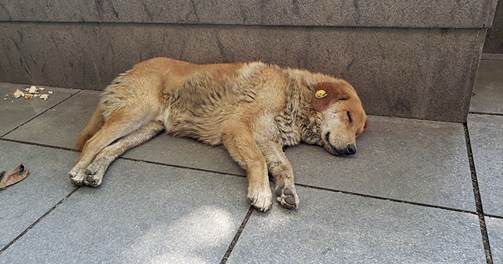
The dog is lying on the steps of the Rustaveli subway. He has a dirty left side, an ear pointed upwards, eyes that follow every passer-by with the precision of someone who has learned to read human beings better than human beings have ever learned to read him. He is one of the estimated forty thousand strays in Tbilisi. Tonight, like every night, the question remains unanswered: How did this come about, and does someone in that warm building across the street intend to do anything about it?
The Shadow of the Yellow Truck
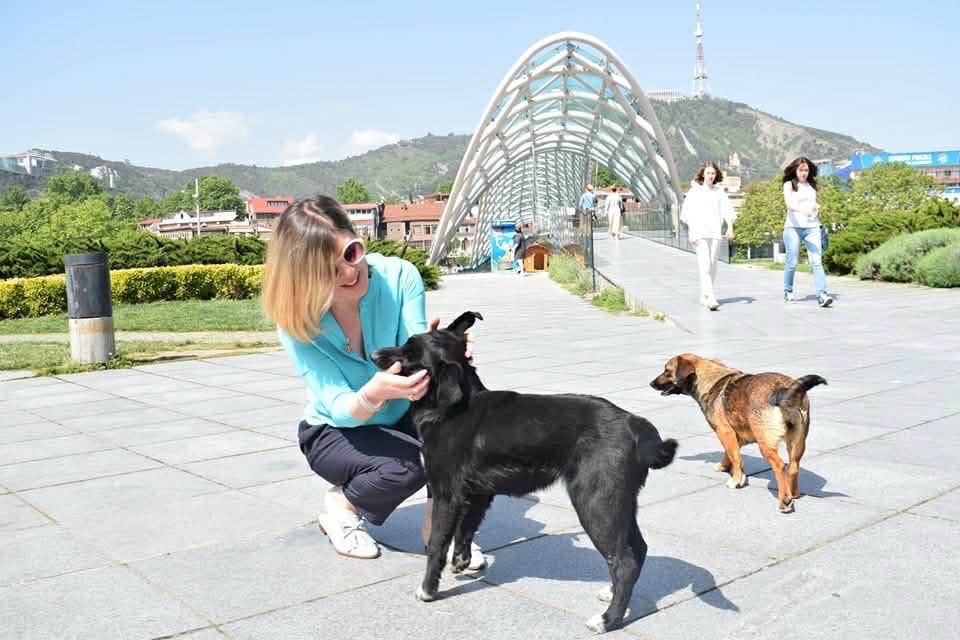
The answer, it seems, is: some of them. Few of them actually, who work with their own money, their own cars and their ability to bear pain, because stray dogs in Georgia have for long remained one of the most sensitive and emotionally charged social issues in the country. This is a reality that is often shocking to foreigners, yet it seems to be almost ordinary for those who grew up in the midst of it. Stray dogs can be found in every part of cities, adapted to human environments, but still vulnerable. Nanuka Dzirtkbilashvili, 43, an animal rights activist has been thinking about it for as long as she can remember. Not as a “social issue” of the kind that is discussed in parliamentary committees, but as a psychological wound imprinted in childhood. On this one, she tells us about the yellow truck. Everyone in her generation in Georgia remembers what the yellow truck means: the rusty municipal vehicle that drove through Soviet and post-Soviet cities picking up strays, and whose appearance on a road was enough to make animals and children like her stop breathing.
How the Soviets dealt with stray animals was really just a reflection of how they dealt with anything they found inconvenient: “a stray animal was associated with garbage,” she says. The logic, in fact, was consistent as brutal; what is classified as waste can be removed without much ceremony. The classic approach: to make it disappear and to call it a solution. They were not euthanized, she tells me, because at least that word would imply some kind of cure.
Decades later, methods have changed, but the negligence remains. Between 2008 and 2012, she notes, a company named ‘Debut’ was established and began killing animals. Their method involved a tub of water and an electric current. Eventually, following years of pressure from activists, Georgia officially switched to a sterilization model. Officially.
Dzirtkbilashvili cites the case of Gori, specifically a crematorium and footage that was requested from the authorities but never released. She has suspicions, based on the mathematics of the situation: a regional shelter with only one veterinarian, a euthanasia that takes thirty-five minutes per animal, and the total hours the crematorium operated that night (four to five hours), numbers that simply do not add up compared to the dogs that are no longer there. Similar cases, she says, have been documented in Kakheti.
The Mathematics of the Matter
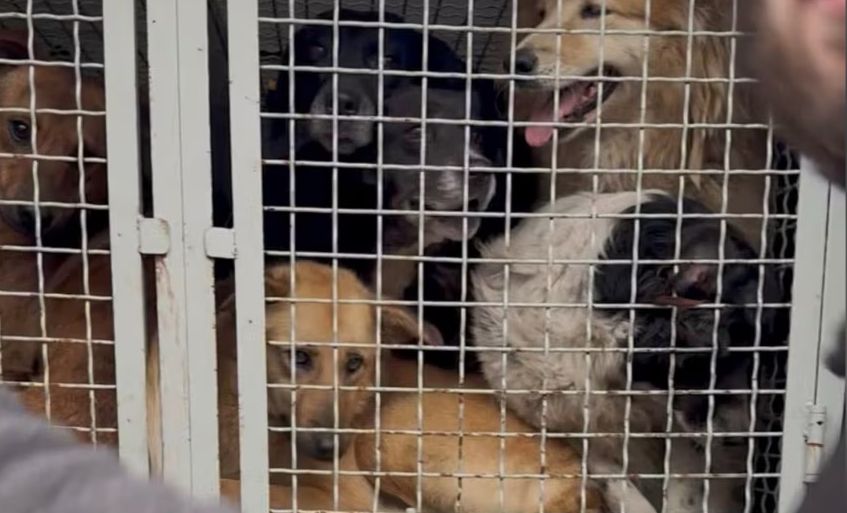
What makes the Georgian situation particularly difficult is that it is not just one problem, but several, layered on top of each other. On the one hand, there are the animals already on the street, cold and vaccinated, on the other, owned animals that reproduce uncontrollably, impulsive purchases of dogs that end up discarded when they become inconvenient, amateur breeders who sell puppies without any knowledge of hereditary diseases.
And then there’s the cultural sediment underneath it all: a rural resistance to sterilization that comes from a genuinely strange confusion.
The counterargument she brings to the villages is pragmatic: a community of dogs adapted to rural life is a lifesaver against wolves and jackals, just to give two examples. Paradoxically, therefore, the animal whose reproduction they fear is the same animal that protects their livestock.
The Membrane
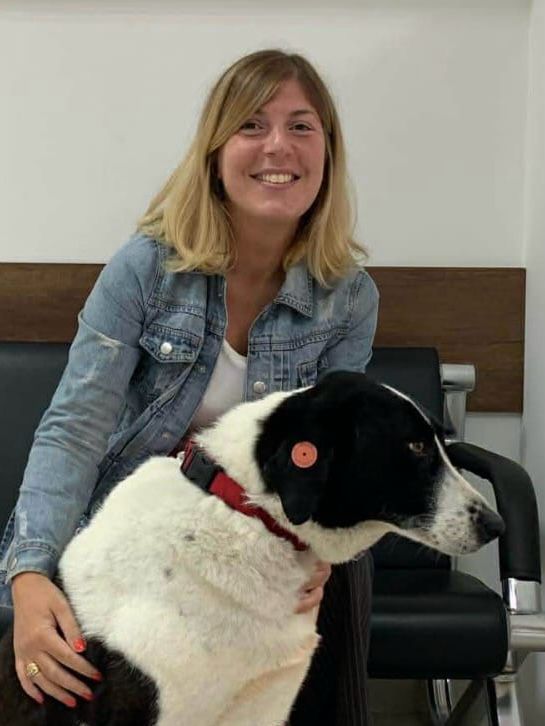
Dzirtkbilashvili keeps three dogs taken from the street in her apartment, but she has lost two recently: one from cancer, one from kidney failure. She mentions it in the way you mention things that are too heavy to turn into an argument. Many other dogs live on the streets but are registered on her name through Georgia’s “attachment” system: each wears an ear tag with a unique code linked to her. She submitted an application to the animal monitoring agency, took formal responsibility, and that means she vaccinates them every year against rabies, checks them, and feeds them. It also means that without her signature, the agency has no right to touch them. She is, for these animals, the membrane between existing in the city and being erased by it.
Visibility as a Solution
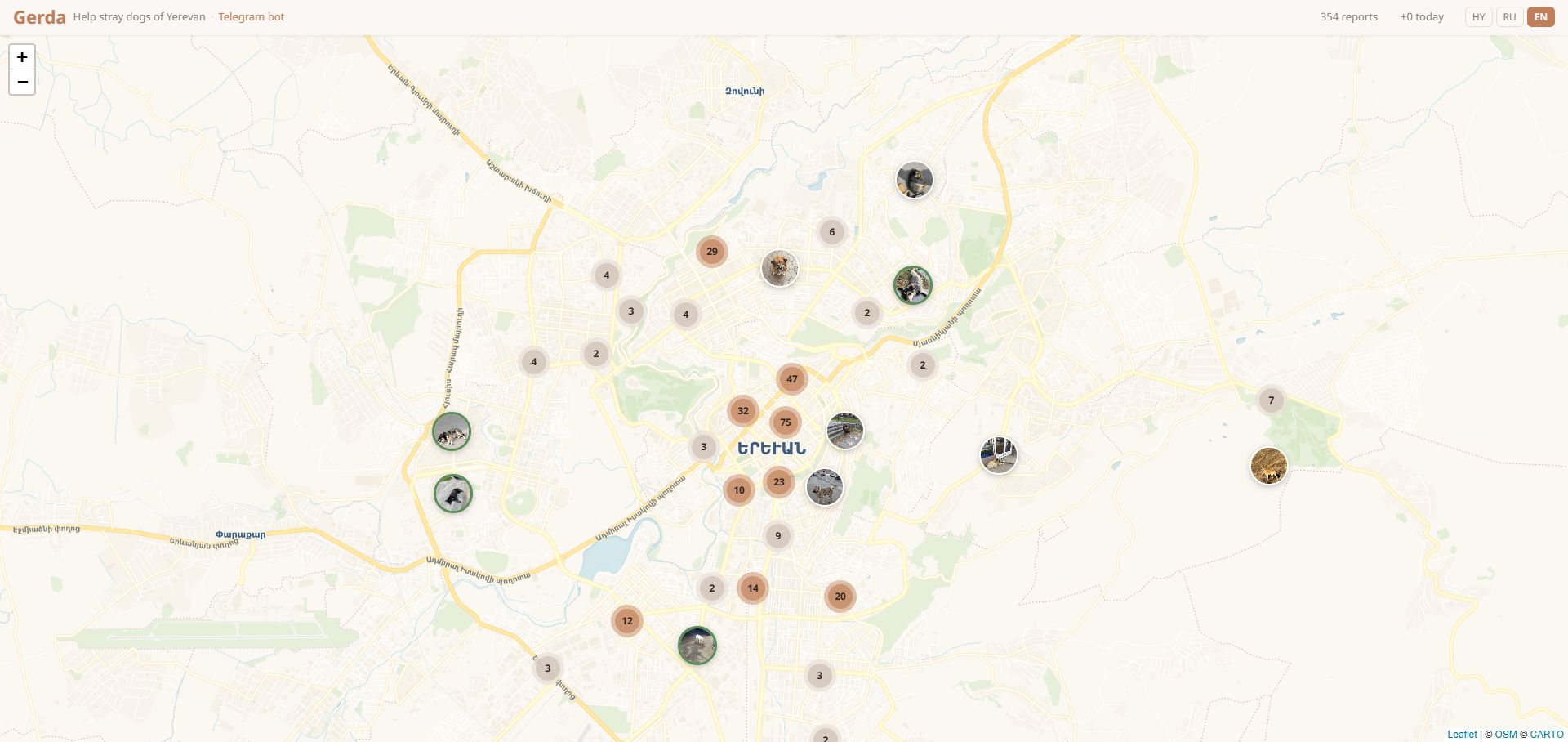
The crisis does not only concern Georgia. Throughout the South Caucasus and the wider post-Soviet region, the same legacy of negligence manifests itself in different registers, perhaps with probably the same yellow trucks under different names, the same late-night screams and the same institutional silence. In Yerevan, Armenia, a group of developers looked at the same problem from a different angle. One of the things that made strays invisible legally, practically and humanly was the absence of a shared and easily available register; Their solution was gerda.am, launched earlier this year: a platform that assigns each registered stray a unique digital profile containing its most frequented location on an interactive map, its medical history and its sterilization status, all this if possible, of course. Thus, a shelter can charge a dog or a volunteer can update its status after a visit to the vet. A potential adopter in another city, or in another country, can find it, see its whole story and start the process. It is a recent tool, whose concrete results are still to be measured, in which the map itself is the key point. Instead of a city full of invisible animals whose fates are unknown even to the people who feed them and live in the city, you get a population, within limits, visible, traceable and verifiable. If a registered dog disappears, someone may notice. If a vaccination is late or absent, it can be reported. No app solves something so deep-rooted and structural, but at least it makes the problem readable and in a region where the default setting has long been to look away, that’s no small feat. When discussing good practice, the Nordic countries are often cited as a benchmark. In Norway, for example, the problem of strays has been tackled through a combination of mass sterilization and castration, mandatory owner registration, severe penalties for abandonment, and structured adoption programs with a drastic reduction in the stray population over time, without resorting to mass euthanasia.
Prevention, adds Dzirtkbilashvili, is always cheaper than management. In Georgia, however, some steps have been taken in this direction. Georgia currently spends large budgets to vaccinate and contain an existing stray population that proper upstream regulation could drastically reduce. Given the resources, the steps it would prioritize follow a clear sequence: first, a temporary ban on uncontrolled farming associated with compulsory sterilisation; therefore the criminalization of animal abandonment and abuse; and, in parallel with both, mass sterilization programs supported by public awareness campaigns. Not one without the other.
Still in the Room
In the meantime, something is also moving at the legislative level. The Georgian parliament is working on a new Law on Companion Animals that provides for unified registration, compulsory sterilization, criminalization of abandonment, and responsibility of municipal shelters. In parallel, the state launched a pilot sterilization program targeting 37,500 owned animals this year, a number that gives an idea of the scale and how far there is still to go. Nanuka attends those meetings every time. Indeed, even on the day of the interview she had just returned from another meeting and would have had another one the next day as well. The law is slow, meetings are slow, and so is bureaucracy, but she’s there, which is more than most people manage to do while working, studying, raising a child, and keeping three stray dogs alive in an apartment.

In The Heart of a Dog, Professor Filipp Filippovič states that the debacle is not in the toilets but in the heads: as long as no one takes responsibility upstream, cleaning up downstream changes nothing. It is exactly the trap Georgia has been in for decades, that is, vaccinating, moving, euthanizing without ever asking why those dogs were there. Georgia is now somewhere in the middle of that transition: no more shooting pincer dogs in the dark, but it hasn’t yet gotten to the point where no dog ends up on the streets.
The dog on the steps of the subway has settled in a new position. One ear is still raised. He is reading the steps of all those who pass by, as well as the age, the mood, the probability of receiving food, with the precision of ten thousand years of living together by our side. We have taken these animals away from the cold. We made sure they needed us. That original act of domestication was a promise of sorts, made so long ago that we mostly forgot we made it. The dog does not.
Transcript by Lidia Davidovi. Translation into Georgian: Lidia Davidovi.