Heart of Georgian Culture - The National Library and Its Priceless Heritage
The National Library of Georgia, known since March 25, 2025 as the “LEPL (Legal Entity of Public Law) Ilia Chavchavadze National Library of Georgia”, in honour of the 19th-century Georgian writer, poet, publisher, and intellectual of the same name, is today the country’s principal bibliographic repository and stands as a true scientific and cultural centre. The decision to name the library after Ilia Chavchavadze is far from random; rather, it reflects a broader and gradual aspiration for independence and detachment from the country’s past and present history, in which Soviet influence in earlier times, and Russian influence today, have played a significant role.
Indeed, Ilia Chavchavadze is regarded as one of the pioneers of Georgian nationalism, so much so that he is often referred to as the “Father of the Nation”. He embodies the model of an intellectual capable of intertwining culture, education, and state-building. He founded and edited newspapers such as Iveria, which served as essential instruments for shaping and consolidating Georgian national identity. Even today, the slogan he coined conveys a message of extraordinary symbolic power: “Ena, Mamuli, Sartsmunoeba” (“Language, Homeland, Faith”). This formula succinctly captures the three pillars of Georgian national identity: language as a cultural foundation, the homeland as a shared political and historical space, and faith as a spiritual and cohesive force. In this sense, the National Library, as the principal guardian of the country’s language and written production, as well as of the broader historical and cultural heritage connected to them, plays a role that can be seen as a continuation of the mission Ilia pursued throughout his life.
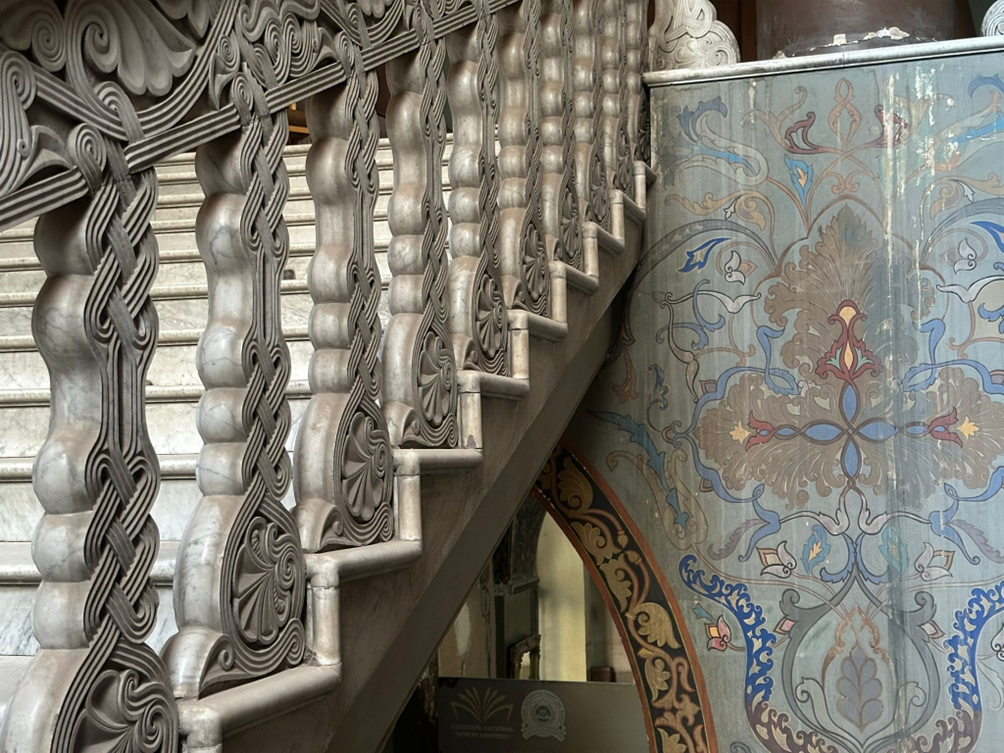
Shifting the focus now to the complex of buildings that make up the National Library, we can identify six in total, three of which are of particular historical and architectural significance. Among these, the first core of the complex certainly stands out: constructed between 1913 and 1916 to house the “Landowners’ Mortgage Bank”, the building became part of the library in 1931. The architectural design was initially entrusted to Anatoli Kalgin, while the interior decorations were created by the painter Henryk Hryniewski. Both were regarded as leading experts in medieval Georgian artistic and architectural styles and were selected with the intention of giving the structure a distinctly traditionalist character, as noted on the library’s official website.
The surviving decorative elements within the building, already mentioned as the work of the Georgian-born painter of Polish origin Henryk Hryniewski, carry even greater significance today. Following the artist’s death sentence and execution during the brutal campaign of political repression, imprisonment, and mass executions orchestrated by the Soviet dictator Joseph Dzhugashvili “Stalin” and remembered as the ‘Great Terror’ (1936–1938), much of his work was destroyed by police forces.
The first core of the complex of buildings that together form the National Library of Georgia is now also home to another remarkable centre of interest, capable of attracting scholars and enthusiasts alike: the “Museum of the Book”.
The museum was inaugurated in 2017. The first of its kind in Georgia, it houses a unique collection of more than 10,000 items, including books and manuscripts, making it the largest and most significant institution of its kind in the Caucasus. Among the many works preserved, particular prominence is given to those originating from the private libraries of distinguished figures such as Ilia Chavchavadze himself, Dimitri Bakradze, and Giorgi Chubinashvili.
Nevertheless, among the true treasures of this collection are several works of extraordinary value, including the Dittionario and the Syntagmatōn linguarum orientalium quae in Georgiae regionibus audiuntur, which we have already discussed in a previous article.
In addition to the previously mentioned works, the museum preserves other items of extraordinary value. Among these, we cannot fail to mention the Sakhareba, also known as the “Gospel Book”. This is the first book ever printed by the first Georgian printing press, founded by King Vakhtang VI of Kartli in 1709. For this work, the printers used the Nuskha-Khutsuri typefaces, traditionally associated with Georgian ecclesiastical writing.
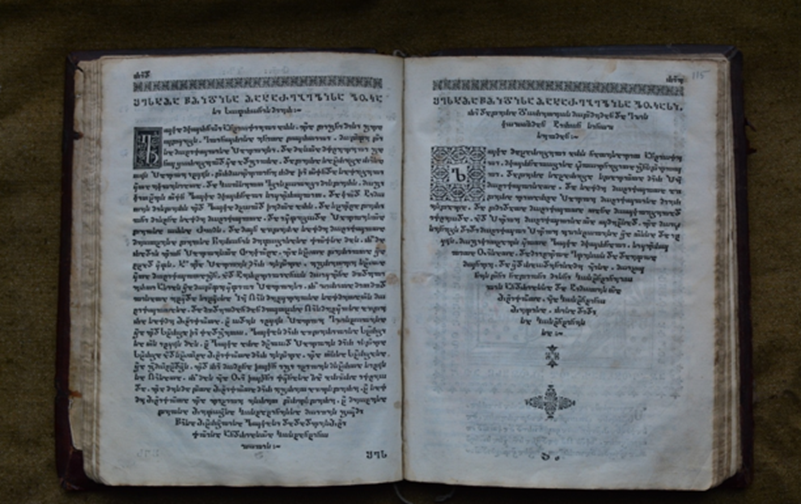
The book opens with the king’s intentions and includes his portrait. The production of the book was entrusted to Mikhail Ishtvanovich, a professional from the territories of present-day Romania, contracted specifically for this project. Mikhail was the assistant and disciple of Anthim the Iberian, a prominent figure in both political and ecclesiastical circles, and the founder of Romania’s first printing press. The book also contains a poem by Anthim, which recounts the history of the first Georgian printing press while praising its financiers and supporters, foremost among them King Vakhtang VI himself.
The edition is richly illustrated, featuring miniatures and iconic paintings of the Blessed Virgin, Jesus Christ, and John the Baptist.
Another work of extraordinary importance preserved in the museum is undoubtedly the Ayat, also known as the “Book of Knowledge”.
Printed in 1721 using the Mkhedruli script, now employed for modern Georgian writing, the work combines astrology, geometry, and philosophy into a single volume. The book owes its creation to the remarkable determination of King Vakhtang VI of Kartli, who, during his imprisonment at the court of the Shah of Persia, translated Persian scientific texts with the aim of enriching Georgian culture.
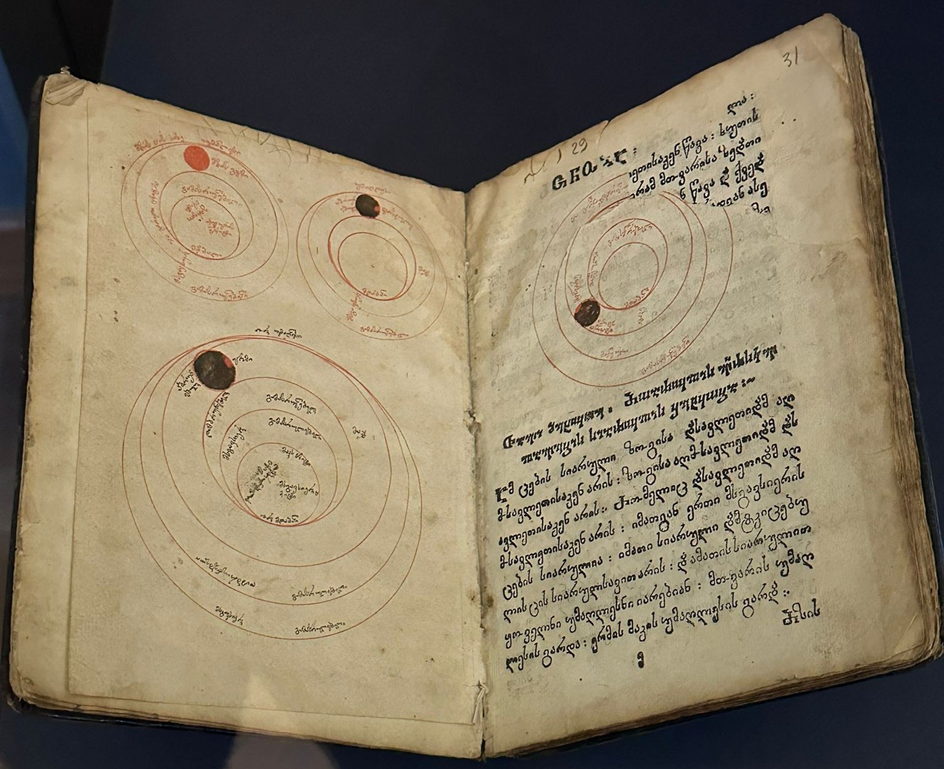
In the preface, Vakhtang VI enthusiastically shares his vision: he wished for young Georgians to “discover the charm of philosophy and begin philosophizing in their own language,” thus issuing a true invitation to knowledge and critical thinking.
At the time, printing constraints meant the illustrations had to be added manually, giving each copy a unique character. A surprising detail: at the time of printing, the original Persian version from which the King had drawn his information had not yet been published!
In conclusion, here it comes another work of extraordinary importance, so significant that it has its own room in the museum: Vepkhistqaosani (The Knight in the Panther’s Skin).
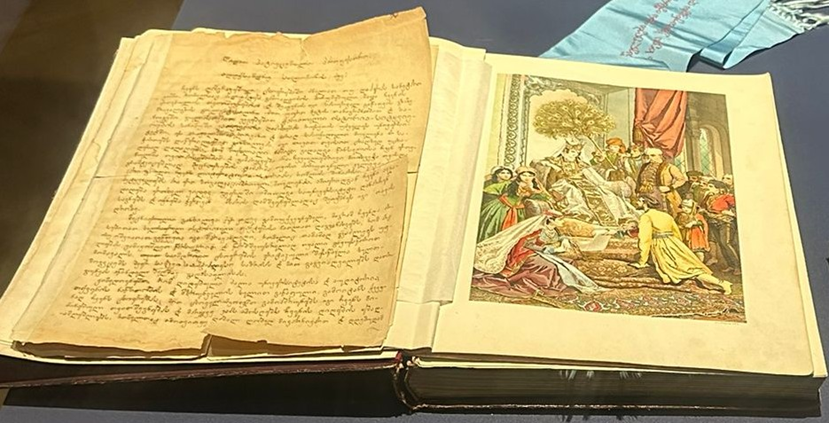
As many will know, the work composed by Shota Rustaveli in the 12th century stands among the greatest masterpieces of Georgian literature. The poem unfolds through roughly 1,600 shairi quatrains, a metrical form that, thanks to Rustaveli’s works, became famous and is now also known as “Rustavelian quatrains.”
Although the poem is set in imaginary lands between India and Arabia, the events narrated in these distant territories are, in fact, a sophisticated allegory of the kingdom of Queen Tamar of Georgia (1184–1213). Behind the exotic landscapes described, one can hear the echo of Georgia at its peak: its Golden Age. This was when the kingdom, under the Queen’s rule, reached the height of its political power, wealth, and cultural prestige.
The National Library of Georgia preserves the very first printed edition of this immensely important work!
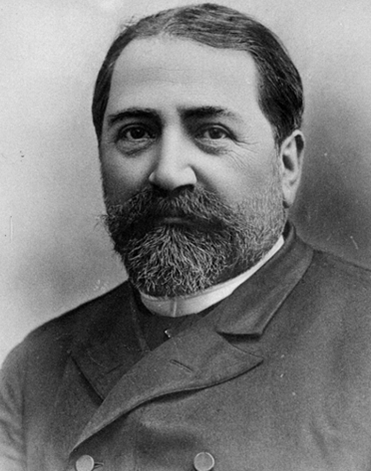
The history of this edition is inseparably linked to the figure of Giorgi Kartvelishvili (1827–1901), an influential Georgian entrepreneur and philanthropist of the 19th century. At a time when Georgia was under Russian imperial rule, Kartvelishvili
distinguished himself through tireless efforts to support and defend national culture. In 1884, he financed the creation of the so-called “Commission for the Establishment of the Authentic Text of Vepkhistqaosani”, bringing together some of the most authoritative figures of Georgian culture of the era: Ilia Chavchavadze, Ivane Machabeli, Rapiel Eristavi, Dimitri Bakradze, Petre Umikashvili, and Iona Meunargia.
The publication was conceived as an editorial work of great prestige. For the occasion, a new typeface and refined ornamental initials were designed. The decorations by Grigol Tatishvili were inspired by the traditional motifs of Georgian Orthodox churches, while the illustrations were entrusted to the Hungarian painter Mihály Zichy, then court artist to the Russian Tsar.
Thus, in 1888, in Tbilisi, the first scholarly edition of The Knight in the Panther’s Skin finally saw the light of day, later known as the “Kartvelishvilian edition”. Giorgi Kartvelishvili then donated the entire first print run to the “Society for the Promotion of Literacy among Georgians”, decisively contributing to the circulation and appreciation of one of the greatest masterpieces of the national literature.