Budrugana Gagra - Theatrical Shadows at Tbilisi
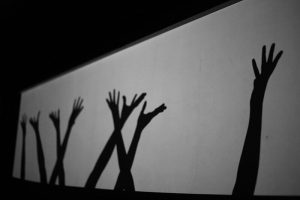
The moment the light falls on the white backdrop and the auditorium sinks into silence, something wholly unconscious takes place, something science calls pareidolia: that ancient, instinctive tendency of the human brain to find familiar forms in ambiguous shapes, to see a face in the bark of a tree or an animal in a passing cloud. On the stage of Tbilisi’s Budrugana Gagra theatre, however, that same tendency becomes art: a hand rises in the darkness, and the audience could swear they are looking at a bear. There are no puppets, no figures cut from cardboard or leather, no sophisticated projectors. There are only ordinary hands, the customary ten fingers and two palms, and a beam of light. With nothing more than this, the Georgian troupe Budrugana Gagra has spent forty years staging performances that have toured the world.
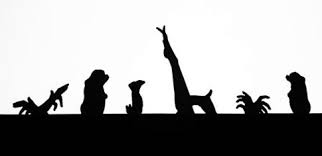
It all began in 1982 with Gela Kandelaki, director and founder of the group. His concern, in those closing years of the Soviet era, is straightforward but urgent: children in the Georgian capital have access to theatre, cinema, and culture; those in the mountain regions and rural periphery do not. He wants to do something about it. He assembles a strikingly heterogeneous group: a dentist, a psychologist, a journalist, united by a single idea: to bring a performance, an inherently cultural moment, to places where nothing and no one tends to arrive. The name he chooses, Budrugana, comes from the seventeenth-century dictionary of Sulkhan-Saba Orbeliani and means a creaking carriage, something that moves, that makes noise, but that eventually reaches its destination. The original plan was a puppet theatre. But puppets cost money, and at the time there was none. Kandelaki looked back to his own childhood, to the shadow games his grandmother had taught him by projecting her hands on the wall. That is where he found the solution, or rather, what he initially took to be a temporary one. “Once the journey had begun,” the troupe recalls, “it became clear that this was something far superior, and the desire to make a puppet theatre vanished entirely.”
The choice of bare hands alone places Budrugana Gagra in a singular position within the universal history of shadow theatre, a tradition whose roots reach deep into Asia and the Middle East.
For its first years, the cast worked in the shadows in the most literal sense: small rehearsals, a limited audience, no official premises. The wider world discovers it almost by accident. An acquaintance brings foreign guests; someone from the art world attends a rehearsal and is left speechless. In 1991, Budrugana Gagra received an invitation to the Marionette Festival in Paris: its first performance before an international audience. The reception is immediate and overwhelming. The date, chosen by fate, carries a symbolic weight that will not be lost on Georgians: on 26th May 1991, while the troupe was in Paris, Georgia held its first post-Soviet presidential elections. A theatre born for children in the provinces finds itself representing its country at the very moment that country is reborn. “International recognition came before recognition at home,” says Kvachakhia. It was only years later that a Georgian Minister of Culture happened to hear about the show during a visit to Lithuania. So struck was he that he arranged for the performance to be broadcast on television: and only then did Georgia rediscover what it had always had.
The war in Abkhazia was not long in coming. Within just a few years of the country’s first free presidential elections, tens of thousands of people had become internally displaced within Georgia. It was at this point that Gela Kandelaki chose to act on his convictions: he founded a second troupe, after the dissolution of the first, drawing largely on young refugees from Abkhazia, and trained them in directing, dramaturgy, and the techniques of shadow theatre. His aim was to give something back to those who had lost everything. From that moment, the name changed: the word Gagra was added, the name of one of Abkhazia’s most beautiful cities, both as a tribute to the origins of the new members and as a declaration of identity. To this day, four of the five permanent members of the troupeare refugees from Abkhazia.
Ketevan Chitadze is a musicologist who teaches at the Tbilisi Conservatoire and at Ilia State University, and a member of the group. She joined almost by chance: she saw a performance with the help of the Conservatory and was struck by its expressive power. Today she is one of the most active members, though when she speaks about the creative process, the vocabulary she reaches for belongs more to musical composition than to theatrical direction. The group’s daily training reflects this same orientation. The exercises for the hands follow no codified technique of the kind one might find in a dance or circus class: the second and third companies trained to jazz compositions, allowing the hands to follow the rhythm freely but with discipline. Music, in Budrugana Gagra, is a load-bearing structure. “Sometimes it is the shadow that evokes the music,” says Chitadze; “sometimes it is the music that brings the shadow to life. The influence runs in both directions.” The repertoire is ambitious: Vivaldi, Bach, jazz. The troupe spent three years on Bach’s St Matthew Passion, from the first analysis of the score to the 2019 premiere.
The notion that the hand possesses its own memory is what neuroscientists call procedural memory: the body’s capacity to execute complex sequences without the mediation of conscious thought. It is the same condition described by virtuoso musicians, dancers, and calligraphers. Zura Kvachakhia, who has large hands and initially doubted they could be of any use, now puts it simply: “The shape of the hand does not matter. The only thing that matters is a love of shadows and that without them you cannot live in this world.”
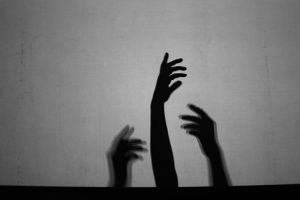
On Budrugana Gagra’s stage, colour does not exist. There is the total darkness of the backdrop and the light that cuts through it, projecting onto the white screen the negative of every gesture. It is an apparently simple contrast, yet one that embraces the conviction that stripping the chromatic palette down to its barest minimum produces a gain in intensity, an art that is finally pure and unencumbered, one in which the dimensions of form and movement are heightened to their fullest. The quality of the light and its hardness, its distance from the hand, its angle determine the character of the shadow. A slight shift can transform a sharp silhouette into something blurred, a steady outline into something restless. “Light is fundamental, one might even say it is the first element,” explains Chitadze. The lighting designer in this theatre is not a technician: they are a co-author. And their role is all the more consequential because, during performances, the use of the voice is simply not possible. “All the energy goes into the hands,” the performers explain. Even the faintest sound breaks concentration, disrupts the flow that holds gesture, rhythm, and shadow together. It is here that the theme of pareidolia reasserts itself: the slightly imprecise shadow, trembling at its edges, unstable, is precisely the one that works best. The audience’s brain labours to complete it, to give it meaning. For the performance to work, it must unfold half on the stage and half in the mind of those watching, demanding an additional, but ultimately rewarding, act of the suspension of disbelief.
The troupe’s most celebrated production is “The Four Seasons”, seven years of work distilled into a performance that crosses all age boundaries. It has been presented alongside the interpretation of the mandolinist Avi Avitali, who performs Vivaldi with the Venice Baroque Orchestra, replacing the violin with the mandolin. In parallel, the troupe has spent years working on a production dedicated to Sulkhan-Saba Orbeliani, the author of the very dictionary from which the name Budrugana derives. The show is not yet finished.
And those future performers may already be at work. The studio that Kandelaki built around the troupe welcomes children and young people into an almost two-year training programme, learning by doing, alongside those who already know. “We hope that, when the time comes, they will be able to take our place,” the group says. The troupe uses the small stage of the Rustaveli Theatre in Tbilisi. There are five permanent members, other jobs to keep things going, and a studio where everything happens: performances, animations, documentaries. Kandelaki has built a space in which everyone can do everything, that was the same collective, artisanal spirit that held together the original group of a dentist, a psychologist, and a journalist.

At the end of the interview, Kvachakhia smiles when asked whether, now that an adequate budget exists, they would transform the troupe into the puppet theatre that was the original intention. “No,” he says. “Mr. Gela says that when he had no money for puppets, he remembered his grandmother. He began with shadows, and realised they were far better. He has never wanted to do anything else since.” The creaking carriage set off from there, from that absence of funds, from that beloved grandmother, from those worn but reassuring hands. And it has not stopped yet.
Transcript by Lidia Davidovi. Translation into Georgian: Lidia Davidovi.