Rome: The Unexpected Cradle of Georgian Printing
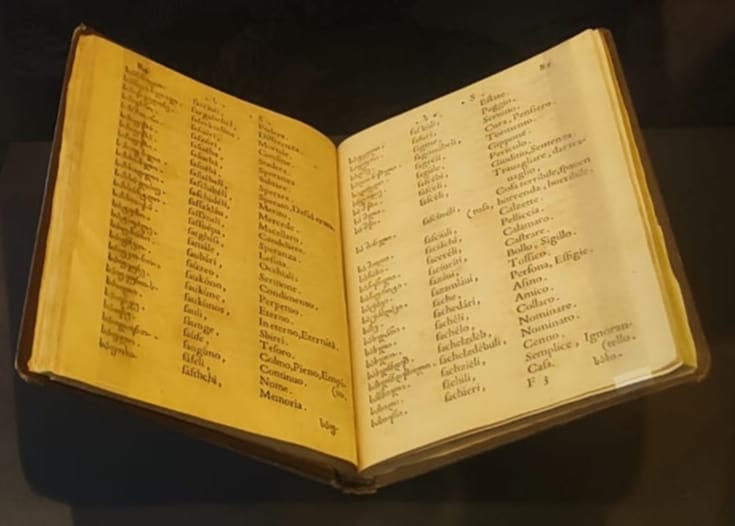
Italy and Georgia lie apart, separated by a mosaic of lands and histories that stretches from the Balkans to the legacy of the Ottoman world, today embodied by Turkey. Yet since the days of Ancient Rome, not even geographical distance has prevented flourishing relations from developing between these two lands. For centuries the country, which has long served as a corridor between Europe and Asia, has seen countless travellers from what is now Italy cross its remarkable territories. Among the most renowned, as we read in his thirteenth-century account Il Milione, is the Venetian Marco Polo, who described the region as a natural fortress, pressed between sea and mountains, while praising its inhabitants for their skills and valour in battle. Among the many stories that weave together the historical ties between the two countries, one in particular stands out, we are referring to the very first book ever printed in the Georgian language: the Dittionario giorgiano e italiano. This remarkable work not only formally linked the languages of the two nations; it was also printed in Rome itself!
It is the first two decades of the 1600s. Nikoloz Irubakidze-Cholokashvili, an erudite cleric and trusted advisor of the crown, known in Europe as Niceforo Irbachi, begins his journey from the lands of what is now the Kakheti region. A monk of the Order of Saint Basil, he is chosen by King Teimuraz I to cross the borders of his kingdom and reach the courts of Europe. Donning the robes of a diplomat, his mission is to persuade European rulers to come to the aid of the small Christian kingdom in the Caucasus, perpetually besieged by Persian attacks.
Unfortunately, the expedition’s primary objective was never achieved. Europe was at the time torn apart by the Thirty Years’ War, one of the most destructive and bloodiest conflicts the continent had ever seen, leaving no sovereign willing to dispatch troops eastward. Yet the journey was not entirely vain. Indeed, in Rome the monk met the Italian Stefano Paolini, and it was precisely through their collaboration that the Dittionario would be printed and published in 1629!
The work was commissioned by missionaries of the Sagra Congregatione de Propaganda Fide, who aimed, through the study of the Georgian language, to make their efforts to spread the Catholic faith in the Caucasus more effective, thereby countering the spread of Protestantism.
The dictionary is structured in three columns: the first presents lemmas following the Georgian alphabet, the second their transliteration into Latin characters, and the third their translation into Italian. Through these pages, as many as 3.084 words provide a window into the world of the two regions during the seventeenth century.
Nowadays, the work is not only a valuable historical and linguistic testament but also a symbol of an ancient dialogue between the two regions, reflecting a shared history. The work is currently housed in the National Library of Georgia in Tbilisi. A complete digital version is now available online, giving scholars and enthusiasts alike the opportunity to consult it for research or deeper study.

In addition to the Dittionario, another remarkable work related to the Georgian language came to light in Rome: the Syntagmatōn linguarum orientalium quae in Georgiae regionibus audiuntur.
The work consist of two distinct books. While the second focuses on Arabic and Turkish, the first serves as a full-fledged manual of Georgian grammar!
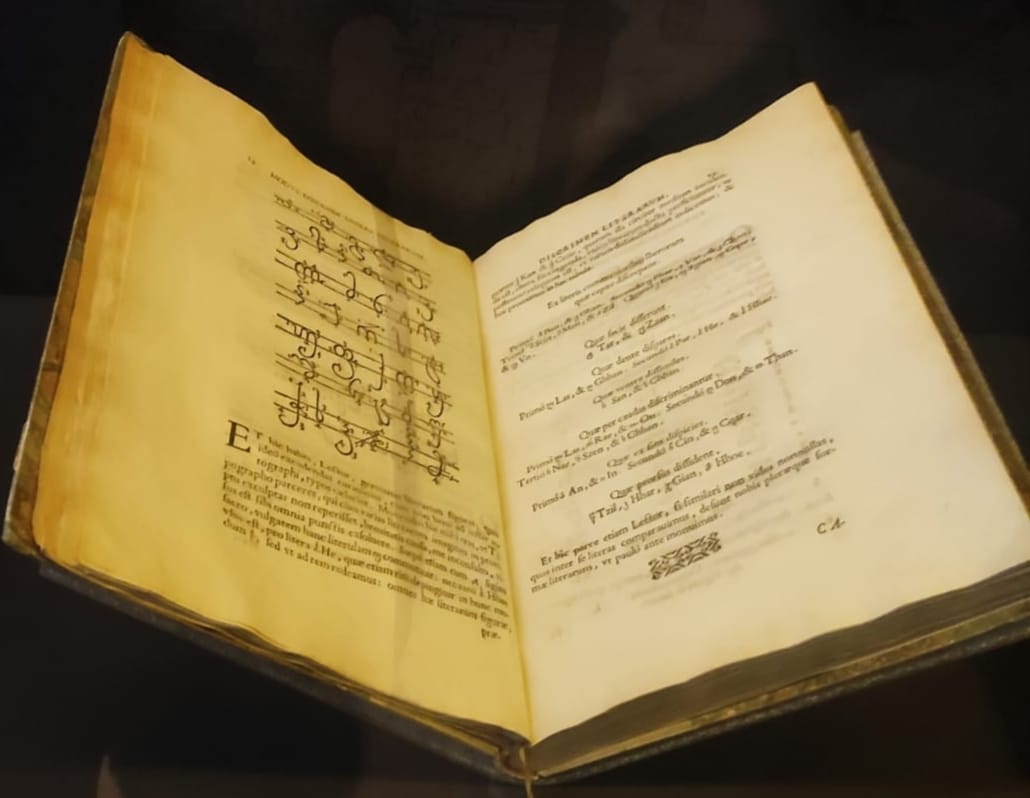
The volume was published in Rome in 1670 by the Sicilian Theatine missionary Francesco Maria Maggio. In the preface, dedicated to Pope Urban VIII, Maggio himself recounts having received from the pontiff the task of mastering the Georgian language. As one can imagine, this was not mere curiosity about a language so different from that of Rome, but a clear mission: to contribute to the spread of the Catholic faith in the Caucasus, armed this time not with the sword, but with grammar, vocabulary, and dialogue.
Nowadays, also this work is housed in the National Library of Georgia in Tbilisi and stands as a valuable testament to the earliest Western studies of the Georgian language.
Yet this treasure is accessible to more than just a handful of scholars; indeed, a complete digital version of the volume is now accessible online!