Interview with Salomea Lominadze - The Equation of the Soul
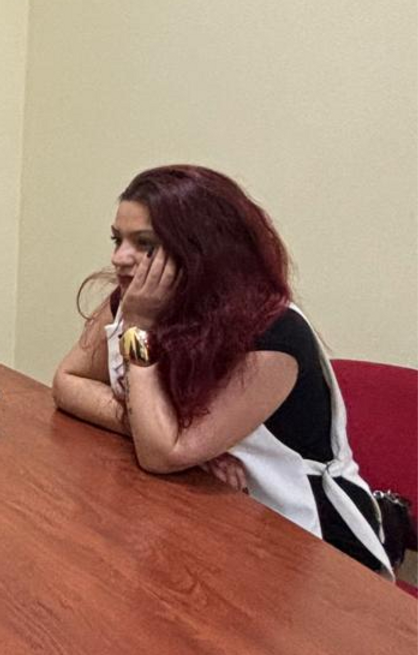 Salomea Lominadze
The Editorial Staff of Kargi Mokalake had the pleasure of welcoming for an interview Salomea Lominadze. We had a pleasant dialogue about writing poetry; her work and we got to know her better. As always, we share with you our conversation. Salomea comes from Ozurgeti, she is a mathematician, mother of two and her career in poetry started 5-6 years ago. She revealed to us that it is very difficult for her to share about herself. She shares with us that: “everyone is quite surprised that I started writing poetry”, even her parents, Salomea said: “my mother is a doctor and my father is a teacher. When literary evenings were held for me in Batumi and Kutaisi, they were very surprised”. In 2022 she published her first book with Intelekti, titled “November’s Sorrow” and also this book was not expected as Salomea refers to us, she didn’t have a lot of experience back then. Salomea had a very first contact with poetry back in school, but being passionate in math, since she later became a mathematician, she revealed us: “I used to think this [poetry RN] was something for lazy people, so I had no interest in literature”. In University then she studied calculus. Salomea wrote her first poem to go through personal problems: “I broke up with my husband, and during that time, I sent my poems to a literary newspaper to be published”. At first Salomea, started to write poetry on her own Facebook profile, but then, the manager of the Facebook group “Poeziari” collected those and started publishing them on their page. It was at that moment that she started thinking about her book and started writing it. At that point, she asked Vakhtang Javakhadze [Chief Editor of the Publishing House Intelekti RN] to edit the content, and he called her and asked why she had not turn in something before. Salomea answered she was not writing before that. It is for this reason that she refers to poetry as: “a talent that suddenly erupted and revealed itself in me as the ability to write”. After this she published on various journals, such as “Mtsvane Kvavila”, “Chorokhma” and “Tsiskar”. We asked then to Salomea if she had any sources of inspiration, or writers she enjoyed reading. She mentioned Terenti Graneli as her favorite poet. Salomea referenced her favorite Georgian poets, Galaktioni and Graneli, in her poetry: “Gala is the song of my passion,
Graneli, I love you more like a child.”
Moreover, while elaborating on that, she explained: “in a country where Galaktion Tabidze, Terenti Graneli, Otar Chiladze, and many other great writers once lived — everything has already been written, and nothing new will be written after that”. It is for this reason that she prefers speaking about her own experiences, personal pains and life stories. Melody also plays a huge role in Salomea’s poetry: she mostly writes in the conventional form, with cross rhymes, but has also experimented with free verse. She told us: “ultimately I follow the melody that comes into my head”. To write, Salomea highly relies on her emotions, and for this reason she said to us that writing a poem might be a bit long. Salomea directly refers to a release of emotions she built up inside herself. She explains: ”poetry writing technique can be learned, and then it becomes natural”, but it has occurred to her to stop writing for 2-3 moths, because inspiration was not there. When the Muse comes then, she would write as soon as she has a line in her head. She elaborates on this: “there have been times when I was cooking, and I left the food and wrote a poem; or at night, when I couldn’t sleep” so, she does not deliberately sit for writing, and she does not need a specific environment. She has also written in public transportation. Sometimes however, she takes some time for the process: “I might smoke a whole pack of cigarettes and sip a bit of wine. That’s when I write best”. The goals of Salomea’s poetry are to survive and: “for others to see themselves in them [her poems RN]”. Salomea thinks that participating in poetry competitions is nice because of the atmosphere created by other writers all being in one place. Her book participated to the Saba Literary Prize, but she didn’t make it to the finals, although she is not disappointed by this. In relation to events with other writers we also spoke about the experience of Salomea to see her poems translated to Serbian language. In this project, six Serbian poets visited through the Association of Writers of Serbia and six Georgian female poets participated. In this occasion, Salomea refers that: “translating poetry proved to be very difficult”. In that context, explaining the meaning of her poems was also complicated, because the audience reacted with surprise.
We also discussed about Salomea’s condition of female writer in Georgia. She explained: “. I think that in Georgia, a female writer must have experienced some great tragedy or event in her life”. Her poems are directly connected to her condition as a woman, and as a single mom, that she has been for many years. “Longing” is for her a keyword to poetry. She elaborated: “My poems are also about loneliness (I have been a single mother for many years), my pain, longing, love, and “not having”. Many women, therefore, feel linked to her poems and words, maybe because they experience the same, Salomea suggested. One of the most powerful messages in Salomea’s poems is “We must survive”, referred to women.
When speaking of unfinished poems that she still is working on, she answers positively and explained to us she has: “Poems begun from stop to stop, postponed like a meeting with a new love—I even mention this in one of my poems”. Also, she opens up about everyone having something like an unfinished poem.
For future plans, she confesses she is collecting poems for a book that will be published in the next three years, and then she promises to her readers never to change.
In conclusion, our chat with Salomea touched many arguments and we managed to get to know her a little bit better. We are grateful for our conversation and hope we can see more from her in the future.