Interview with Ninuka Qoiava - The creative universe of a female artist in Georgia
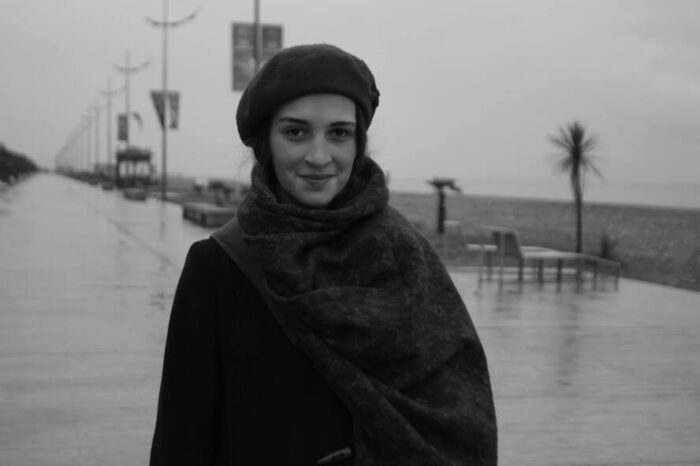 Ninuka Qoiava
The Editorial Staff of Kargi Mokalake had the pleasure of inviting the poet Ninuka Koyavafor an interview. She reached us in our office, and we had a pleasant conversation about various themes: how did she start writing, what her interests and plans are and now we are sharing with you our conversation.
Ninuka introduces herself saying that for as long as she can remember she has always been writing or painting. She studied documentary filmmaking and then after filming some documentaries, she understood that it was not her true calling: she realized that writing was taking up more space in her life: “whether in the form of diaries, vlogs, poems, or scripts. Eventually, I realized I needed to let go of everything else.” We also asked about her family and their possible connection to writing but Ninuka opened about her difficult family situation. Ninuka told us: “My father abducted my mother at an early age, and she has never seen anything of life.”, but Ninuka’s sister is a ballerina and on Ninuka’s Instagram profile there is a video of her sister dancing while the poet acted a piece of poetry.
Ninuka started writing back in school: “I started writing poems more consciously when we were given homework assignments, and I’d respond in poetic form”. Her first poem was published on “Jejili” but she revealed that her parents were more excited about it than she was. During adolescence, Ninuka used writing to go through a difficult period of her life, she recalled: “My diaries became my friends — I shared my emotions with them, and they made me feel less alone. Life felt more bearable that way”. More recently, however, Ninuka has stopped using writing as a therapy: “I put in real effort and work hard to develop my craft […] it takes discipline, responsibility, and dedication”. At the same time though, she describes writing as an action that never feels like work, together with painting. Although, the process of starting writing professionally was not easy and automatic, Ninuka said it took between six and seven years to start publishing and described it as a: “Difficult and emotionally exhausting”. She enjoys being read by older people, who start their day by reading the newspaper, also because she feels lost in the digital world, even if she has been a ghostwriter for a blog, but: “I don’t enjoy writing statuses, and to be honest, the online space intimidates me. I feel like so much talent and hard work just gets lost in there”. So far, she has been publishing on various newspapers, such as “Arili,” “Literary Georgia,” “Literary Newspaper,” and “Georgian Literature”.
Ninuka spoke to us about her creativity and named the photographer Francesca Woodman (a photographer raised in Venice R.N.) as a big source of inspiration, she described her photos as deeply spiritual, with an emotional narrative which she feels drawn to describe. Ninuka said: “Whenever I look at her work, I feel a strong urge to write — to capture and express what’s happening in that single moment frozen in the photo”. Ninuka discovered Woodman’s work online and has been a source of inspiration both for writing and drawing ever since. Ninuka especially praises the way Francesca made use of the naked body, which was restricted when Ninuka was studying theatre, she told us: “But Francesca had a free and fearless approach — she conveyed women’s suffering, sadness, and emotional pain without compromise”. When asking whether she is more inspired by daily life or imagined episodes, Ninuka answered: “I believe there’s such a faint line between real and imagined stories”. She hopes for a more mature style in the future, when she will be able to describe people’s emotions and actions without actually knowing them. Emotions are a strong drive to write for Ninuka, she likes to write when she wants to feel better, as she already mentioned, she used it for therapeutical purposes: “I believe poetry is the gym for the brain and soul”. When asking about other authors that inspire her, Ninuka mentioned Pushkin and Dante, but also said: “I don’t get inspiration from writers, but it could be something awful that I’ve heard, or new information I picked up from the TV, or something I saw on the internet, or just something I witnessed with my own eyes. It could even be a story that happened to my friend”. When we asked about writing rituals, Ninuka told us about the importance of being alone while writing and her difficulty to do so as a mother. She also listens to music, a big inspiration for her is Ryuichi Sakamoto’s “Merry Christmas, Mr. Lawrence”.
The Magazine Kargi Mokalake has received a poem by Ninuka Koyava titled “The Flowers Have Moved”, for this reason, we asked Ninuka to elaborate more about this piece. She describes the central idea of the poem as “An expression of the feeling when you return to a place where you spent the years and stages of your life, and in your memory, those places haven’t really moved elsewhere”. So, the main emotions are discomfort and the sadness of realizing that everything is different now and that time has passed. She explains to us once again that emotions are deeply connected to her writing, that has a different perspective from the objectivity of journalists: she describes what she feels: “I want the stories that hurt my heart to just be sad for my readers”. We asked about a specific stanza of the poem and its meaning:
“Now they have been defeated
And we can assume,
That the place was once
Filled with flowers every season,
But something must have happened,
And all they said about them was this…”
She specified that she really wanted to convey the image of time passing: walls may crumble after one’s passing, flowers may flourish, or they may disappear because no one is taking care of them anymore.
We also asked about Ninuka’s experience of being a female writer, she is a mother, therefore her situation is unique compared to other poets we interviewed. Ninuka was reluctant to describe this because she feels she is a woman in a very small circle. She talked about how close her bond is with her friend and shared some very personal details from their friendship. They exchanged writings about the feelings they observed after masturbation: a big taboo in our contemporary society. The need to speak of this arose from the impossibility of discussing this with everyone else and describes a clear feminine experience in society. She describes this as a natural continuation and consequence of her work: “When you don’t write children’s fairy tales but describe your inner world and show it to people, it can cause great anger in people, or it can bring you shame and harm”. This is also connected to another comment she received, someone told her: “You really write well, but it clearly seems like it’s written by a woman, and maybe you should try working on that”. She felt embarrassed and then gave it a go to write in a genderless manner, but then she understood it was impossible to do so: she is a woman and is determined in writing the way she perceives the world.
As already mentioned, Ninuka is not only a poet, but she also draws and paints. She uses painting as a sort of escapism from the others’ judgement, as there is not a third eye, she says. She likes the process of painting and declared: “The work with colors itself is very enjoyable, and during this process, I have gotten ideas for writing”. Ninuka is deeply inspired by Edvard Munch in painting and was offered to participate in some exhibitions, but she never accepted. We hope to be able to see her work soon.
Because of mentioning Francesca Woodman and Dante we also spoke about similarities and differences between Georgia and Italy. It turns out that the two countries have a lot in common in terms of history and character. Ninuka feels like Georgia is: “A country where you can sit in any street corner, write, draw, or take photos, and it will always be interesting”, while travelling abroad she feels intimidated in doing so. For this reason, she prefers to talk to people who are not familiar with Georgia, so that she can tell them fairytales about it.
At the same time, Ninuka reports that working in Georgia is a struggle, as in her opinion, education is not supported enough, and reading is not popularized. She quotes a well-known Georgian author Nodar Dumbadze, who said: “You don’t need education or age to enjoy holding a book in your hands”. For this reason, Ninuka points out the difficulty in popularizing Georgian literature without a solid background in society about education and reading.
Ninuka reports that she never participated in any competition or won any grant, she feels uncomfortable with the idea of being judged and for future plans she speaks about her poetry collection, soon-to-be published (in June 2025 RN). Ninuka also expresses the desire to unite all of her material in a single work but still needs the courage to do so.
We had a pleasant chat with Ninuka Koyava, we hope to see her work soon, both in painting and writing and hope she has a brilliant future as an artist ahead of her. We deeply thank her for the time she lent us for this interview.
Greta Miravalle